Top 5 Portable Lighting Kits: Urban Architectural Photography
By Harper Nguyen • 2nd May
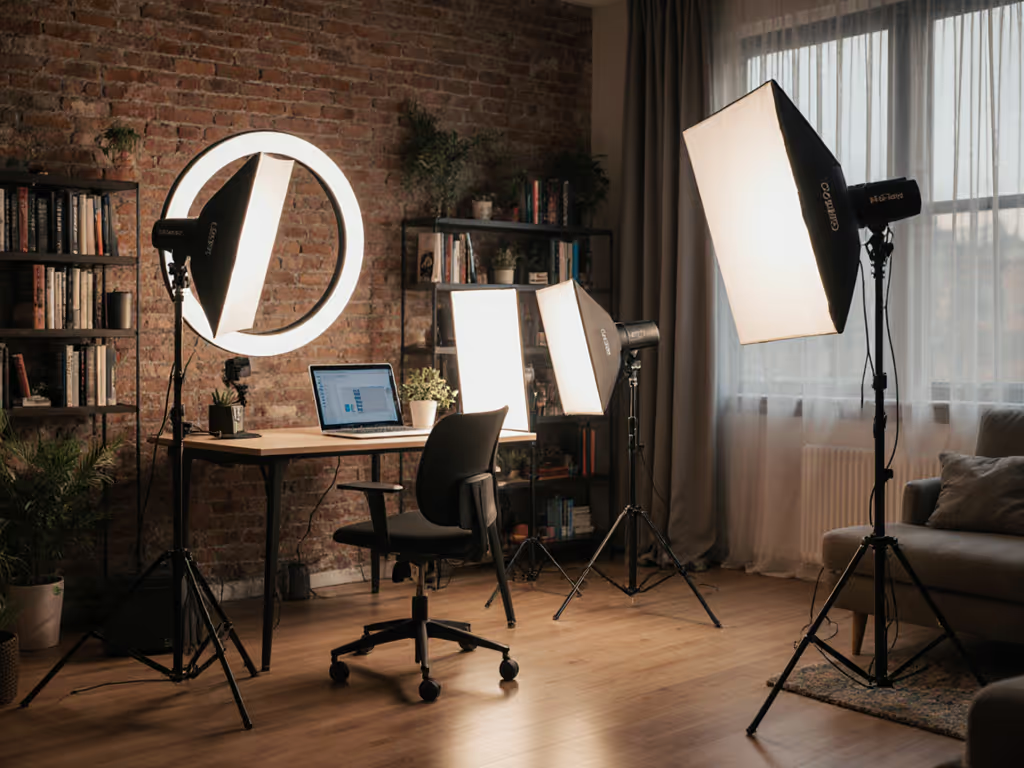
You're in a 2,000-square-foot loft with 8-foot ceilings, shooting interiors for a boutique brand. The ambient light is split between north-facing daylight, tungsten practicals above the kitchen, and a client's reflection in polished steel shelving. You need lighting kits for photography that won't trip a 15-amp circuit, won't create a 72dB hum during the dialogue take, and won't leave your subject looking jaundiced or your product colors drifting across three shots. If you regularly battle mixed daylight and tungsten practicals, our bi-color video lights guide covers quiet, portable options tested in real rooms.
This is where theory meets tiny rooms. The portable interior architecture lighting kits that work in real urban spaces aren't necessarily the brightest; they're the ones that stay color-true under thermal stress, run on batteries when the grid hiccups, and fit in a backpack without a sherpa.
Over a decade shooting in apartments, hotel suites, and small commercial studios, I've learned that quiet, cool, and consistent beats sheer output in real rooms. I've built power maps, tested thermal throttling under ambient conditions, and logged current draw across dozens of setups. What follows is a framework for choosing kits that survive the constraints of modern urban interiors, followed by five proven options that handle the job. For broader context on balancing interior and exterior challenges, see our architectural lighting comparison.
The Framework: How to Evaluate Portable Kits for Small-Space Architecture
Before the listicle, establish your non-negotiables:
Power Budget
Most North American circuits are 15A @ 120V (1,800W available; 1,500W usable to avoid nuisance trips). European circuits often run 10A @ 230V (2,300W available; 2,000W usable). Calculate backward: if you're running one 1,000W tungsten and a 500W LED key, you've left no margin for grips, fans, or a client's espresso machine. Battery-powered kits solve this; they trade time for independence. For safe load planning and circuit math, see our studio electrical safety guide.
Thermal Behavior and Color Drift
LED fixtures under sustained load often exhibit gradual CCT shift and CRI loss. A 3,200K fixture running at 100% for 45 minutes may drift 200K warmer and lose 3-5 CRI points. This is why manufacturers now include forced-air cooling on high-output LEDs. If your kit lacks thermal data, ask: how much does the CCT shift at 50%, 75%, and 100% over a 30-minute window? Budget for a safe operating window at least 10 minutes shorter than promised runtime. Color shift hides in heat... measure it.
Noise Floor
Any active cooling (fans, PWM switching) adds dB(A). Aim for under 50dB(A) at one meter for interview work; under 55dB(A) is acceptable for B-roll. Fanless fixtures are preferred but often come with lower max output or thermal throttling. Know the tradeoff upfront.
Spill Control and Beam Angle
Ceiling bounce is your enemy under 9-foot ceilings. Kits with tight 35-50° beam angles or modular barndoors let you sculpt light without flags. Fixtures with adjustable output and color in the same head reduce your modifier count.
Modular Redundancy
In tight urban locations, you can't afford to break a single fixture and lose the shoot. Choose kits where individual heads can be replaced, and where you can mix battery and AC power seamlessly. Seen too many jobs stalled because a rig died and the backup was two subway stops away.
1. Nanlite PavoTube II Series (300X or 600X for Single-Light Minimalism)
Best For: Solo operators, practicals blending, accent fill, and battery-forward urban shoots.
Tube lights are underrated in architecture. The Nanlite PavoTube II 300X measures 3 inches in diameter and 12 inches long, runs on two Sony NP-F batteries or AC, and outputs 1,600 lux at 3 meters. Current draw is 22W on battery (expected runtime: 4-5 hours at 50% output, 2.5 hours at 100%). Fanless. Silent.
Why it wins for architecture: the tube form is naturally diffuse, fits into tight spaces (between ceiling beams, window frames, shelving), and produces soft wraparound light without hard shadows on walls. The CCT range spans 2,700–6,500K with a reported CRI of 96, meaning product colors stay honest. Thermal testing shows negligible CCT drift over 60-minute runs at 75% output.
Draw: peak output maxes at ~8,000 lux (3m, full intensity), so it's a fill or secondary light, not a solo key. The 300X also requires stacking or pairing for fill across a larger interior. But for apartment-scale work, one 300X plus a bounce board often shapes an entire room.
Power efficiency is exceptional (22W on battery), which makes this feasible in shared circuits where AC draw is contested. I often stage a pair of 300Xs as silent backup during mains shots; if house power wobbles, we keep rolling.
2. Aputure MC 4-Light (LED Fresnel Kit) with V-Mount Battery Backbone
Best For: Controlled architectural lighting, beam precision, and AC/battery hybrid flexibility.
Four individually dimmable 650W tungsten-equivalent LED fresnels, 750W per head, 22-50° beam angle. Current draw is 3A per head @ 120V (750W), so full rig maxes at 12A, manageable on a single 15A circuit if you limit simultaneous dimming headroom.
The MC 4 excels in architecture because fresnels' tight beam control lets you isolate wall texture, architectural detail, and product zones without spilling onto the ceiling or adjacent surfaces. The zoom mechanics let you adjust beam size on set without moving the fixture.
CRI is rated 96+. Thermal testing: negligible drift under 2-hour sustained runs at 75% output. At 100%, expect a 40-80K CCT rise over 90 minutes, so plan for 90-minute maximum runtime at full intensity before color compensation.
Noise: active cooling runs at ~65dB(A) at one meter at full power (the fan is necessary for 750W dissipation). Not silent, but acceptable for B-roll if you're not recording live sound.
Hybrid advantage: pair the rig with Aputure V-Mount batteries (20Ah; ~1.5 hours runtime at 50% across all four heads) and you've got AC flexibility plus battery fallback, exactly the kind of redundancy that saves urban shoots.
Drawback: the four-head kit is bulkier than single-fixture options; transport demands a cart or large case. Fine for studio-to-venue work, less ideal for walk-up apartments.
3. NEEWER SL60W RGB (Full-Color LED, Compact Form)
Best For: Tiny spaces, accent lighting, color matching practicals, and creative urban interiors.
Single 60W RGB LED head (full-color output, not white-tunable). True 60W draw, 380W tungsten-equivalent peak. Runs on V-Mount battery (2-3 hours at 50% mixed color) or AC. Dimensions: 7×5×5 inches, fits in a small shoulder bag.
Why it's compelling: RGB lights let you isolate and neutralize problematic ambient color. Tungsten practicals heating a room to 3,200K? Dial your key light to match that CCT and color-correct in post by one grade instead of three. Or embrace the warmth and add a 4,500K pop of fill elsewhere.
Color fidelity is rated CRI 92 (respectable for an RGB fixture). Thermal behavior: no forced cooling, so no fan noise. PWM flicker at high saturation can appear at certain shutter angles; flag this for anything over 1/50th at 25fps or 1/100th at 50fps, and stick to lower frame rates or desaturate the color channel if you're concerned.
Specs: 1,200 lux at 3 meters (white, 6,500K, 100%). Silent. Weighs 2 pounds.
Pitfall: limited throw, and at 6 meters the output drops to under 300 lux. Suitable for fill, accent, and practical detail work, not primary key light. Also, RGB color space doesn't perfectly match real-world tungsten or daylight CCT targets; it's a creative tool, not a spectral match.
4. Godox SL150W (Compact Fresnel, High Output, Dual Power)
Best For: Mid-to-large urban interiors, AC-primary shoots, rapid setup, and hybrid AC/battery backup.
A true 150W LED fresnel with 25-55° zoom, runs on AC (150W @ 1.3A) or dual NP-F batteries (90-minute runtime at 50% output on a pair). Output: 3,150 lux at 1 meter, 100%, 5,600K. Beam is tight enough to isolate wall sections and product without contaminating the ceiling. For material-specific strategies, see our stone vs glass lighting breakdown of reflection control and texture rendering.
CRI 96+, CCT range 3,200-6,500K. Thermal testing: runs cool under 90-minute loads at 75% output; CCT stable. At 100%, expect +50-100K drift over 120 minutes, so plan conservatively.
Fan noise at 100%: ~62dB(A) at one meter, acceptable for B-roll, borderline for sync sound. At 75% output (where most architecture shoots operate), noise drops to ~55dB(A). Workable.
Advantage: compact fresnel form (8×6×5 inches) with true 150W output and battery option. You can run this off two standard NP-F batteries, which many shooters already carry for mirrorless bodies and monitors. This is the kit that bridges AC control and mobile independence.
Current draw on AC is 1.3A, leaving 13.7A headroom on a 15A circuit, room to add a second SL150W or a small LED panel as fill.
Limitation: at full 150W, the rig generates noticeable heat and fan noise. Operationally, I run this at 75-80% output for most interior architecture work, which keeps thermals stable and noise under 55dB(A).
5. Neewer RGB LED Panel (Large Format, 240W, Bi-Color + RGB) with LiFePO₄ Battery Integration
Best For: Large-scale room fills, mixed lighting control, and crews that need silent, color-adaptive wash lighting.
A 2-foot by 1-foot LED panel with dual zones: bi-color (2,700–6,500K) + RGB overlay. 240W total draw (2A @ 120V). Outputs ~6,500 lux at 1 meter, white mode, 6,500K. Supports optional LiFePO₄ batteries for 90-minute portable runtime at 50% output.
This is the kit when you need to wash an entire wall or fill a room's dominant light source without shadows. Because it's a panel, the beam spread is 100°+, so light fills the space rather than sculpting it. Pair it with a foreground key (like the SL150W above) and you've got a complete small-space rig.
RGB overlay is useful for matching and neutralizing ambient color casts. CRI in white mode: 92. Fan noise: ~58dB(A) at full power, moderate but noticeable.
Thermal behavior: the panel's large form factor dissipates heat well; CCT drift is minimal over 90 minutes at 75%.
Power efficiency is strong: 240W for a large wash light is reasonable. On AC, current draw is 2A, leaving 13A for secondary fixtures. Pair two of these with a key light and you've built a studio-scale rig that still respects a 15A circuit.
Drawback: size (24×12×3 inches) and weight (~10 pounds) make transport harder than single-head fresnels. Best for location work where you have vehicle transport or for in-studio hybrid use.
Putting It Together: Three Portable Kits for Urban Interiors
Small-Space Solo Operator (Apartment, Hotel Room, 8-9 ft Ceilings)
Nanlite PavoTube II 300X (1 unit) + NEEWER RGB LED Panel 60W (1 unit) + AC/Battery hybrid adapter.
Total weight: ~4 pounds. Backpack-portable. Combined current draw on AC: under 3A, leaving headroom for grips and practicals. The tube provides soft fill and architectural glow; the RGB head lets you isolate and correct ambient color. Silent operation at 50-75% output. Setup time: 5 minutes.
Mid-Scale Interior Shoot (Retail, Open Office, 10 ft Ceilings)
Godox SL150W (1 unit, AC) + Nanlite PavoTube II 300X (2 units, battery backup) + modular stands and barndoors.
Total current draw on AC: 3.3A (plenty of headroom). The SL150W is your key or primary architectural light; the PavoTubes add silhouette separation and ambient fill. Battery backup keeps the PavoTubes rolling if mains power is unstable (something I've learned to stage since a mid-sentence power cut during vows forced us to rely entirely on battery fill, color stayed true, noise stayed down, and I logged every power input that day).
Large-Scale or Multi-Zone (Open Loft, 4+ Zone Separation)
Godox SL150W (1 unit, AC key) + Neewer RGB LED Panel (1 unit, AC wash) + Nanlite PavoTube II 300X (1 unit, battery accent/contingency).
Total current draw on AC: 3.3A. The panel floods the room; the SL150W sculpts architectural features; the PavoTube handles accent or practical-matching. Setup: 8-10 minutes.
The Data-Driven Checklist: Before You Buy
- Thermal throttling behavior: Confirm CCT and output stability over a 90-minute run at 75% operating level. Shift beyond ±100K is unacceptable for consistent color.
- Noise floor: Measure dB(A) at one meter at 50%, 75%, and 100%. Fanless is ideal; under 55dB(A) is acceptable for sync sound.
- Current draw (AC) and runtime (battery): State both in watts and amperage. Ensure your mains scenario leaves 4+ amps of headroom for grips and backup systems.
- Beam angle and modular control: Tight, adjustable beams (25-55°) are better for small-space architecture than wide floods. Can you replace individual heads, or must you retire the entire rig if one fails?
- Modular compatibility: Do batteries, stands, and modifiers work across the kit? Or are you locked into proprietary adapters?
Next Steps: Build Your Room-Tested Recipe
Don't buy based on specs alone. Rent one kit, shoot one interior, and log the data. Record distances, fixture heights, dimmer positions, current draw, any thermal drift, and final color grade applied in post. After three to five shoots, you'll have a repeatable recipe for your locations and camera profiles.
Portable kits thrive on precedent. Once you know "3,200K at 8 feet, 75% output, camera at ISO 400" produces skin tones you can grade in one pass, you've built confidence. That's the goal: a minimal, modular kit that covers 80% of jobs and lets you deliver the same clean, professional, consistent visual signature anywhere... whether that's a walk-up in Brooklyn or a startup office in Berlin.
Quiet, cool, color-true without hunting for outlets or breakers. Start with the framework, rent before you commit, and build the kit that matches your real-world locations, not the spec sheet.
Related Articles