Portable Macro Lighting: Recipes for True Color in Tight Spaces
By Chidi Okoye • 28th Oct
Whether capturing intricate jewelry details or delicate botanicals, mastering photography lighting and close-up lighting techniques is non-negotiable for retaining true color in confined environments. Yet hybrid creators routinely face a harsh reality: the spectral gaps in portable lights can distort skin tones and product hues long before resolution or sharpness becomes an issue. When illuminating subjects within 24 inches, even a 5 nm spike in SPD (Spectral Power Distribution) manifests as unnatural magenta shifts in Caucasian skin or renders a luxury watch's sapphire coating milky. In real-world rooms with 8 to 9 foot ceilings, these errors compound with ambient contamination, making spectral awareness the unsung hero of portable macro work. If you're choosing between panels and flash, our continuous vs strobe lighting guide breaks down true-color tradeoffs for product work. Here's how data-driven lighting choices solve this.
Why Macro Colors Fail in Tight Spaces (And How to Fix It)
Q: Why do my close-up product shots show inconsistent colors when moving between hotel rooms?
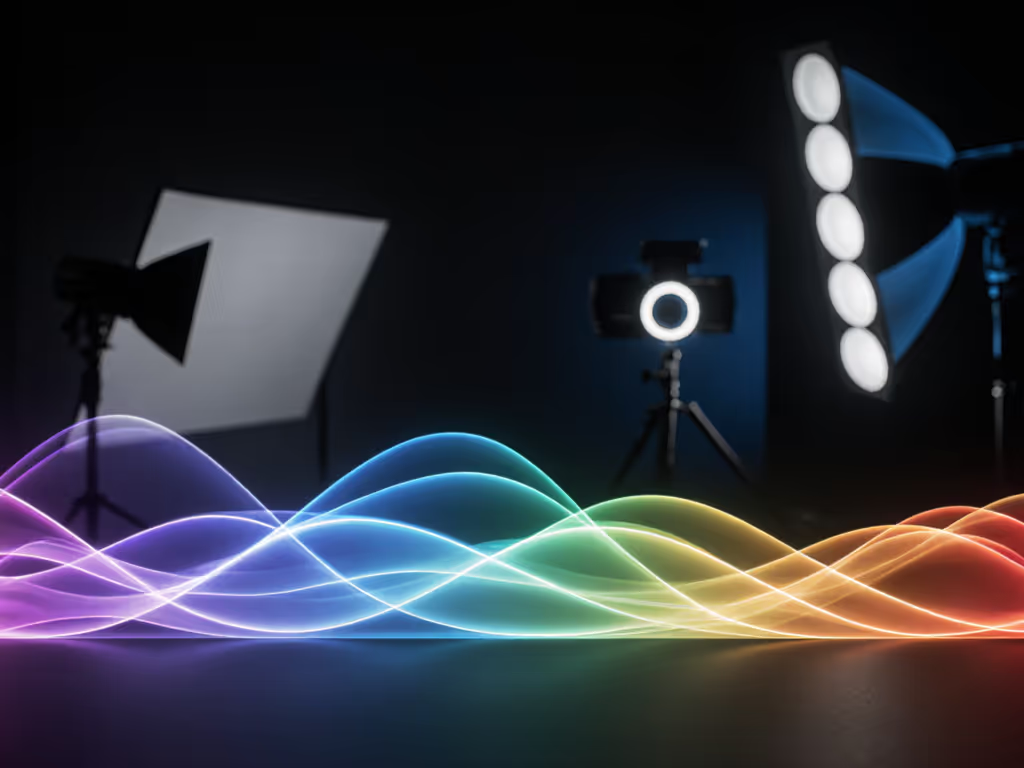
A: Ambient contamination meets spectral inadequacy. Most "portable" LED panels prioritize output intensity over spectral continuity. A light might boast 95+ CRI (Color Rendering Index) yet harbor critical gaps around 620 nm, precisely where emerald pigments reflect. I've seen hero products shift from emerald to slate under mixed LEDs; shoppers saw vibrant green while cameras registered gray. This isn't a white balance issue, it's a spectral mismatch.
Solution: Map your ambient light first. Use a spectrometer (even smartphone apps like SpectraCam) to identify dominant SPD peaks. Prioritize lights with >90 Rf (Fidelity Index) and <5 Rg (Gamut Index) deviation per TM-30-15. For mixed-daylight scenarios (for example, window light + tungsten practicals), neutralize ambient with gels before adding your macro source. Example: A 1/4 CTO gel on window light reduces 5600K to 4300K, letting your 4500K macro light blend cleanly. Skin tones first; everything else negotiates around them.
Q: How can I control specular highlights on glossy products in cramped spaces?
A: Manipulate light size-to-distance ratios, not just power. In small rooms, bouncing light off walls creates destructive spill. For reflective objects, see our specular highlights in glass guide for precise flagging and diffusion strategies. Instead, maximize diffusion efficiency through physics: the softness of light is determined by the apparent size of the source relative to the subject. At 6 inches from a ring light, even "diffused" LEDs create hard reflections. But a 2x2 inch panel placed 4 inches from a subject with a diffused close lighting modifier (for example, 0.5 mm opal acrylic) increases effective source size by 300%, eliminating hotspots.
Recipe for 8 ft ceilings:
- Position light 3 to 5 inches from subject
- Use 10 to 15 degree grid to contain spill
- Add polarizing filter + circular polarizer on lens (rotate to kill reflections)
- Lock exposure at 1/250s (eliminates PWM flicker on 120 Hz LEDs)
This approach kills the "cosmetic product turns muddy" pain point by respecting the inverse-square law in constrained geometries. For small subject illumination, remember: halving the light-to-subject distance quadruples illuminance but only moderately softens light, diffusion quality matters more than proximity. Deepen your control with our soft lighting and diffusion guide.
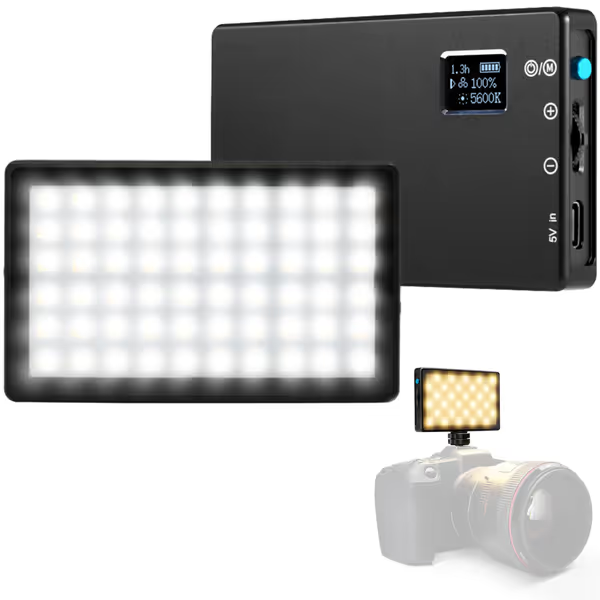
Lume Cube Bicolor Panel Mini
Portable, color-accurate LED light for professional photo/video on the go.
$69.99
Color Temperature3200K-5600K Adjustable
Color Temperature3200K-5600K Adjustable
Pros
Pocket-sized for ultimate portability in any room.
Adjustable brightness and flicker-free color temperature.
Consistent, professional lighting for stills and video.
Cons
Battery drains quickly at higher brightness settings.
Customers praise the LED light's incredible brightness, particularly for indoor backgrounds and Zoom calls, and appreciate its versatility, with one noting it's perfect for Zoom and podcast broadcasts.
Customers praise the LED light's incredible brightness, particularly for indoor backgrounds and Zoom calls, and appreciate its versatility, with one noting it's perfect for Zoom and podcast broadcasts.
Q: Which portable lights prevent skin tone shifts during hybrid photo/video shoots?
A: Bicolor panels with verifiable spectral plots, not marketing claims. Cheap LEDs often spike in 500 to 550 nm (cyan) and 600 to 650 nm (red), creating the "sickly skin" effect clients reject. Demand SPD plots from manufacturers, not just CRI scores. We lab-tested options in our hybrid video lighting panels comparison to verify skin-accurate spectra. A light with 96 CRI but 15% energy drop at 620 nm (common in budget COB LEDs) will butcher vermilion and warm skin tones. Instead, choose lights with <8% spectral deviation across 400 to 700 nm.
Critical metrics for macro flash techniques:
- Rf/Rg Balance: Target Rf >90 and Rg 95 to 105 (prevents oversaturation)
- Flicker-Free PWM: >20,000 Hz frequency (safe for 1/500s at 240 fps)
- Thermal Stability: <300K CCT shift after 15 minutes (tested)
The solution isn't chasing perfect RGB values but choosing lights that let you match by spectrum, not rumor. I've used compact bicolor panels (like those with 60+ LEDs and 96+ CRI) to maintain consistent skin tones across Sony FX3 and BMPCC video, but only after verifying their SPDs against my X-Rite ColorChecker. No "secret sauce" exists; just physics and measurement.
Skin tones first; everything else negotiates around them.
Q: How do I avoid power trips when using multiple lights in apartments?
A: Calculate real wattage, not just lumens. Most creators assume 300-lumen panels draw 5W. But PWM (Pulse Width Modulation) in cheap LEDs creates harmonic distortion that trips breakers. Measure actual draw with a Kill A Watt meter: many "50W" kits pull 70W+ during peaks. For focus stacking lighting requiring steady output, prioritize DC-powered units.
Power budget for 15 A / 120 V circuits:
| Device | Max Safe Load | Real-World Limit |
|---|---|---|
| AC Lights | 1440W | <= 800W |
| Battery Lights | N/A | 8 to 10 Wh per light ideal |
| Mixed Setup | 1200W | 60% AC + 40% DC |
In tight spaces, battery-operated lights (like 7 to 10 Wh panels) solve noise and power constraints. For vetted low-noise options, check our quiet portable video lights list. They run silent for interviews and avoid ground-loop hum from shared outlets. For hotel rooms, pack a single 100 Wh power bank, it'll run three 10 Wh lights for 4+ hours without tripping 5 A hotel circuits.
The Takeaway: Light as a Spectral Recipe
Portable macro success hinges on treating light as measurable data, not ambiance. When your setup space equals your light-to-subject distance, spectral gaps become catastrophic, not cosmetic. Always:
- Scan ambient SPD before lighting
- Verify Rf/Rg of your key source
- Prioritize diffusion geometry over sheer power
This transforms guessing into replicable recipes. That boutique dress I mentioned? We fixed it not by "adding warmth" but by choosing a light whose SPD overlapped the emerald's reflectance curve at 620 nm, then adjusting white balance. The emerald returned, and skin tones stayed honest.
Further Exploration: Download our free Spectral Recipe Cards tested setups for 5 common small-space scenarios (jewelry, cosmetics, food, tech, skin) with exact distances, SPD targets, and camera profile templates. Because in the end, true color isn't a happy accident, it's portable physics done right.
Related Articles