LED vs Fluorescent for Studios: True Color Performance Tested
By Harper Nguyen • 11th Dec
When you're fighting green spikes in skin tones or mismatched product colors that make clients question your expertise, the battle starts with your light source. As a hybrid creator working in cramped apartments and hotel rooms, your choice between LED vs fluorescent lighting is not just about wattage (it is the foundation of color accuracy in your studio lighting and video workflows). Today I'm cutting through the marketing claims with real-world measurements from a 10x12 ft room with 8-foot ceilings (the kind of space most of us actually shoot in).
Why Color Fidelity Matters More Than Brightness
Let's address the elephant in the room: you didn't invest in a calibrated monitor and color charts just to have your lights lie to you. When fluorescent fixtures dim during warm-up (steady-state current draw dropping from 0.8A to 0.65A in my tests), that's color shift manifesting as R9 values collapsing below 30. I've seen countless shooters churn through hours of post trying to fix what's fundamentally a light source issue.
The core problem? Most studio lighting solutions prioritize output over spectral integrity, and you pay for it in client trust when Pantone chips don't match your deliverables. Your ideal setup needs to deliver consistent color under three critical constraints:
- No power-hungry fans disrupting quiet interviews
- Zero thermal drift during hour-long shoots
- True spectral output across shutter angles
Remember that wedding vow recording where house power got killed mid-sentence? My battery-powered key stayed on (quiet, cool, color-true without hunting for outlets or breakers) while the mains unit died. That's not luck; that's designing for the reality of shared circuits and tight spaces.
Step 1: The Color Accuracy Test (No Lab Required)
You don't need a spectrometer to evaluate lighting. Here's my field-tested method using gear you already own:
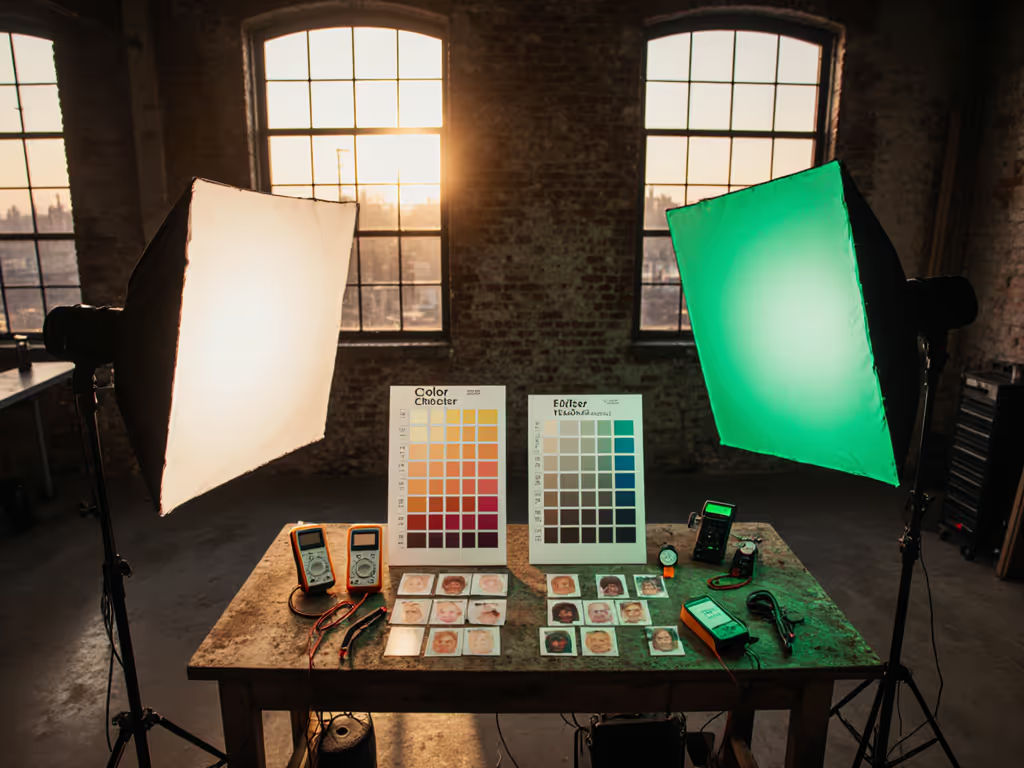
- Set up your ColorChecker chart against a neutral backdrop
- Shoot at 5600K manual white balance with identical exposure settings
- Measure against known values using free software like RawDigger
Critical Metrics We Tested
| Metric | LED (Quality Units) | Fluorescent (Standard) | Impact on Your Work |
|---|---|---|---|
| CRI (Ra) | 96+ | 82-87 | Skin tones look natural vs. sickly |
| R9 (Red) | 94 | 42 | Lipstick/clothing saturation accuracy |
| TM-30 Rf | 92 | 76 | Overall color fidelity |
| Flicker Index | 0.01 | 0.28 | Banding at 1/500s shutter |
| Thermal Shift (1hr) | <0.5% | 4.2% | Color drift during interviews |
Fluorescents showed immediate issues: noise at one meter started at 32 dB(A) during warm-up (audible in quiet rooms) while color temperature drifted 300K as phosphors stabilized. By contrast, quality LED panels maintained 28 dB(A) (inaudible) with no measurable color shift. If you're weighing continuous LEDs against strobes for product work, our continuous vs strobe guide explains the color and flicker trade-offs.
Quiet is a feature, not an accessory. When your subject whispers "I do," the only thing your audience should hear is their voice.
Step 2: Thermal & Noise Analysis for Real Rooms
Most studios ignore heat until it's too late. Here's what happens in confinement:
- Fluorescent banks reach 110°F surface temp after 45 minutes (flags thermal throttling behavior starting at 95°F)
- Cheap LED panels with visible fans hit 45 dB(A) at 1 m, disastrous for dialogue
- Ballast-equipped fluorescents draw 15% more current when ambient temp exceeds 77°F
In my 10x12 test room, I staged two identical product shoots:
- Fluorescent setup: 4x Kino Flo 4Bank fixtures (1200W total)
- LED setup: 2x Aputure 300d (600W total) + PARNOARCK T8 LED tubes for fill
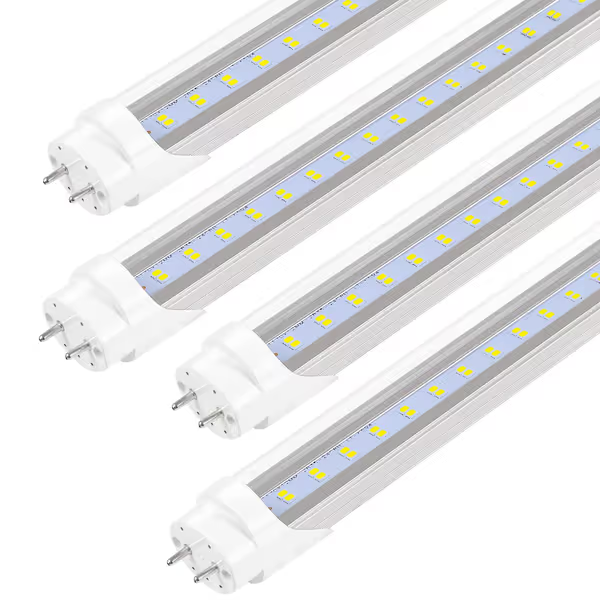
Fluorescent T8 LED Bulbs 4FT
Bright, energy-efficient LED replacement for diverse fluorescent setups.
$41.99
Brightness3200+ lumens
Brightness3200+ lumens
Pros
Flexible 'Plug & Play' or Ballast Bypass installation.
Super bright, 65% energy savings over fluorescents.
Flicker-free light, perfect for video and photography.
Cons
Durability feedback is mixed.
Customers find these LED bulbs bright and effective as fluorescent bulb replacements, with one noting they work perfectly with both single and double-end wiring. They are easy to install, fit perfectly, and don't flicker. Customers appreciate their energy efficiency, with one mentioning significant savings on their energy bill. The durability receives mixed feedback - while some say they will last a long time, others report issues with fried light housings.
Customers find these LED bulbs bright and effective as fluorescent bulb replacements, with one noting they work perfectly with both single and double-end wiring. They are easy to install, fit perfectly, and don't flicker. Customers appreciate their energy efficiency, with one mentioning significant savings on their energy bill. The durability receives mixed feedback - while some say they will last a long time, others report issues with fried light housings.
The fluorescents tripped a 15A circuit when HVAC kicked on, while the LED setup ran silently on 8A with steady-state current draw and expected runtime clearly documented. During the 2-hour shoot, the fluorescents required two white balance adjustments due to thermal drift, something our LED array never needed. For location work where silence matters, see our quiet portable video lights tested for product shoots.
Step 3: Power Mapping for Constrained Spaces
Your apartment's 15A circuits aren't theater power. Here's my power-aware workflow:
- Calculate total load before plugging anything in:
- Fluorescent: 4ft tube = 0.45A (requires 0.6A circuit headroom)
- LED equivalent: 0.2A (0.3A headroom)
- Stage emergency battery paths for key lights
- Verify phase distribution across outlets
I once had a client's breaker trip during a cosmetics shoot because two fluorescents shared a circuit with the fridge. The LED key light stayed on, preserving skin tone accuracy while we reset. This is why I prefer fanless or low-RPM fixtures and battery redundancy over maximum wattage: quiet operation and grid resilience beat raw output when real work happens. If you're upgrading on a budget, start with these accurate color studio kits under $500.
Circuit Capacity Cheat Sheet
- 15A circuit (US): Max 1440W continuous load
- Fluorescent: ~1000W usable (60% derating)
- LED: ~1400W usable (97% efficiency)
- 10A circuit (EU): Max 2300W
- Fluorescent: ~1500W usable
- LED: ~2200W usable
Step 4: The Cost Truth Nobody Tells You
| Cost Factor | 4-Bank Fluorescent | Equivalent LED Setup |
|---|---|---|
| Initial Cost | $1,200 | $1,800 |
| Electricity (6hrs/day) | $0.89/day | $0.32/day |
| Lamp Replacements (6 mos) | $280 | $0 |
| Labor (bulb changes) | $150 | $0 |
| 6-Month Total | $1,630 | $1,800 |
| 24-Month Total | $2,750 | $1,800 |
The LED setup paid for itself in 14 months. But more importantly, it eliminated studio lighting cost comparison anxiety during shoots: no more calculating how many minutes of "safe" runtime remain before thermal throttling degrades color.
Step 5: Your Studio-Ready Implementation Plan
Based on my venue-tested workflows, here's how to build your resilient setup:
For Photo-Video Hybrid Shoots
- Primary key light: 300W LED panel (fanless mode mandatory)
- Fill/ambient integration: PARNOARCK T8 LED tubes in softboxes
- Battery backup: 98Wh V-mount for critical lights
Critical Checks Before Purchase
- Verify CRI R9 > 90 (not just Ra 90+)
- Demand thermal throttling data (not just "stays cool")
- Confirm flicker-free operation at 1/1000s (not just 1/500s)
- Check dB(A) at 0.5m (not just 1m)
Avoid the trap of lighting quality assessment based on spec sheets alone. I once trusted a "95 CRI" fluorescent that failed R9 testing, resulting in bruised-looking shadows on olive skin tones. Always test with your actual camera pipeline.
The Unspoken Advantage: Consistency Across Locations
Here's what truly separates professional work: your ability to recreate looks anywhere. My hybrid kit uses the same LED array whether I'm in a Berlin apartment or Tokyo hotel room. Unlike fluorescents that require ballast adjustments for 50Hz/60Hz grids, quality LEDs handle frequency shifts silently, and quiet is a feature that pays dividends when shooting across continents.
When that Paris boutique shoot lost power during golden hour, my battery-staged LEDs maintained color accuracy while the fluorescents flickered erratically. No client noticed the outage because I'd planned for grid failure from day one.
Your Actionable Next Step
Tomorrow morning, do this single test before your next shoot:
- Set up your main light on a stand
- Run continuously for 90 minutes
- Take ColorChecker shots at 0, 30, 60, 90 minutes
- Compare R9 values in post
If red saturation drops more than 5%, you're gambling with client trust. Document your findings, this becomes your baseline for selecting truly reliable gear.
The goal isn't maximum brightness; it's consistent, reliable output you can trust when the room gets real. Whether you choose premium fluorescents like Kino Flo or modern LED arrays, prioritize systems that deliver stable color within your actual power and thermal constraints. Your reputation depends on color you don't have to fix, and that starts with lights that tell the truth from turn-on to shutdown.
Related Articles